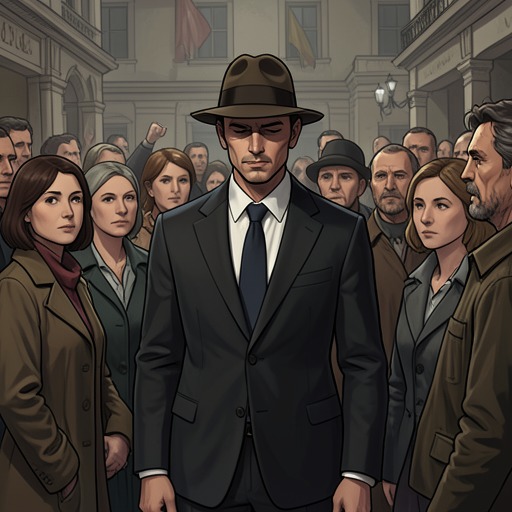
I am become a name
The Cuckoo's Calling“I am become a name” is the phrase Cormoran Strike recalls in the final scene of The Cuckoo’s Calling, drawing on lines from Tennyson’s “Ulysses.” It gives literary form to Strike’s recognition of himself as a person becoming known, while placing that recognition beside the poem’s restless account of a life still in motion.
The phrase’s source and return
After Strike clearly gives his name to a doctor, he limps after the doctor and finds that a phrase has risen from his subconscious. The thought precedes his conscious identification of its source: he remembers having read it long before encounters that later marked his life, including seeing a dead body, witnessing a waterfall in an African mountainside, and watching a killer realize he had been caught. The novel thus presents the line as an old literary memory returning in the wake of accumulated experience.
Strike initially recalls the short declaration, “I am become a name.” It takes him several minutes to recover the surrounding lines, a delay that makes the quotation feel less like a prepared motto than a fragment gradually retrieved. Its return connects his earlier reading to the person he has become, without suggesting that the phrase had guided him throughout the intervening years.
The closing quotation
The recovered passage begins, “I cannot rest from travel: I will drink / Life to the lees,” and continues through the speaker’s recollection of what he has loved “on shore and when / Thro’ scudding drifts the rainy Hyades / Vext the dim sea.” Strike reaches the phrase again in this fuller context: “I am become a name…” The ellipsis preserves the sense of a quotation trailing onward, while the passage’s emphasis on travel and experience resonates with the history Strike has just mentally surveyed.
The quotation appears as Strike lies back on the examination table, having been asked to remove his prosthesis. The doctor bends over the remainder of his leg, but Strike’s attention turns inward to the lines he is trying to remember. The scene’s immediate medical setting and the poem’s expansive language sit beside one another: the body requires practical attention, while the recalled passage gathers the wider course of a life into a literary phrase.
Identity and ending
The line’s placement makes naming its immediate context. Strike has just introduced himself by name, and the phrase that surfaces is explicitly about becoming one. The moment does not establish fame or public recognition as a completed achievement; rather, it frames identity as something that has taken shape through a succession of experiences, among them detective work and personal encounters with death and danger.
As the novel’s closing expression, “I am become a name” leaves Strike’s story oriented toward continuation rather than rest. Its surrounding lines speak of travel and sustained engagement with life, giving the ending a forward pull. The quotation does not resolve Strike’s future; it offers a compact image of a person whose name, work, and accumulated experience have begun to converge.